T-Shirt Size Chart: Complete Measurement Guide for Custom Apparel
There is no universal t-shirt size standard — every factory grades differently. Confirm chest, body length, and sleeve measurements with your manufacturer before bulk orders.
AI-generated summary
If you're ordering custom t-shirts, the size chart you approve during sampling is the one every customer receives. A half-inch error in chest width across a full size run means returns, reprints, and complaints you didn't budget for.
Most sizing problems in custom apparel don't come from bad stitching. They come from buyers who skipped measurement verification, guessed at regional conversions, or assumed a "standard" size chart exists. It doesn't. Every manufacturer grades sizes differently.
This guide gives you working size charts for men's, women's, youth, and unisex t-shirts, plus regional conversions, print placement dimensions, and the production checkpoints that keep your size run accurate from sample to bulk.
Quick Answer: Standard T-Shirt Size Charts
These are general-purpose measurement ranges based on common industry standards. Always confirm exact measurements with your manufacturer, because grade rules vary by factory and fabric type.
Men's / Unisex T-Shirt Size Chart
| Size | Chest (in) | Chest (cm) | Body Length (in) | Body Length (cm) | Sleeve Length (in) |
|---|---|---|---|---|---|
| S | 36–38 | 91–97 | 28 | 71 | 8.5 |
| M | 39–41 | 99–104 | 29 | 74 | 9.0 |
| L | 42–44 | 107–112 | 30 | 76 | 9.5 |
| XL | 45–48 | 114–122 | 31 | 79 | 10.0 |
| 2XL | 49–52 | 124–132 | 32 | 81 | 10.5 |
| 3XL | 53–56 | 135–142 | 33 | 84 | 11.0 |
Women's T-Shirt Size Chart
| Size | Bust (in) | Bust (cm) | Body Length (in) | Body Length (cm) |
|---|---|---|---|---|
| XS | 31–33 | 79–84 | 26 | 66 |
| S | 34–36 | 86–91 | 27 | 69 |
| M | 37–39 | 94–99 | 28 | 71 |
| L | 40–42 | 102–107 | 29 | 74 |
| XL | 43–46 | 109–117 | 30 | 76 |
| 2XL | 47–50 | 119–127 | 31 | 79 |
Youth T-Shirt Size Chart
| Size | Age Range | Chest (in) | Chest (cm) | Body Length (in) |
|---|---|---|---|---|
| YXS | 2–4 | 22–24 | 56–61 | 18 |
| YS | 6–8 | 25–27 | 64–69 | 20 |
| YM | 10–12 | 28–30 | 71–76 | 22 |
| YL | 14–16 | 31–33 | 79–84 | 24 |
| YXL | 18–20 | 34–36 | 86–91 | 26 |
Kids / Toddler T-Shirt Size Chart
| Size | Age | Chest (in) | Body Length (in) |
|---|---|---|---|
| 2T | 2 | 21 | 14 |
| 3T | 3 | 22 | 15 |
| 4T | 4 | 23 | 16 |
| 5–6 | 5–6 | 24–25 | 18 |
Rule of Thumb: Chest measurements are taken flat across the garment, then doubled. A size M listed at 39–41" means the flat panel measures 19.5–20.5" across.
Need a custom size chart built for your brand's fit and demographic? SuhuCustom develops factory-verified size charts as part of every custom t-shirt order — send your tech pack or target measurements and the team will lock down the numbers before sampling. Start Your Free Quote
How to Measure a T-Shirt Correctly
If you're sending measurements to a manufacturer or building a size chart for your store, measure the same way every time. Inconsistent measuring is the #1 cause of sample-to-bulk mismatch.
Three Measurements You Need
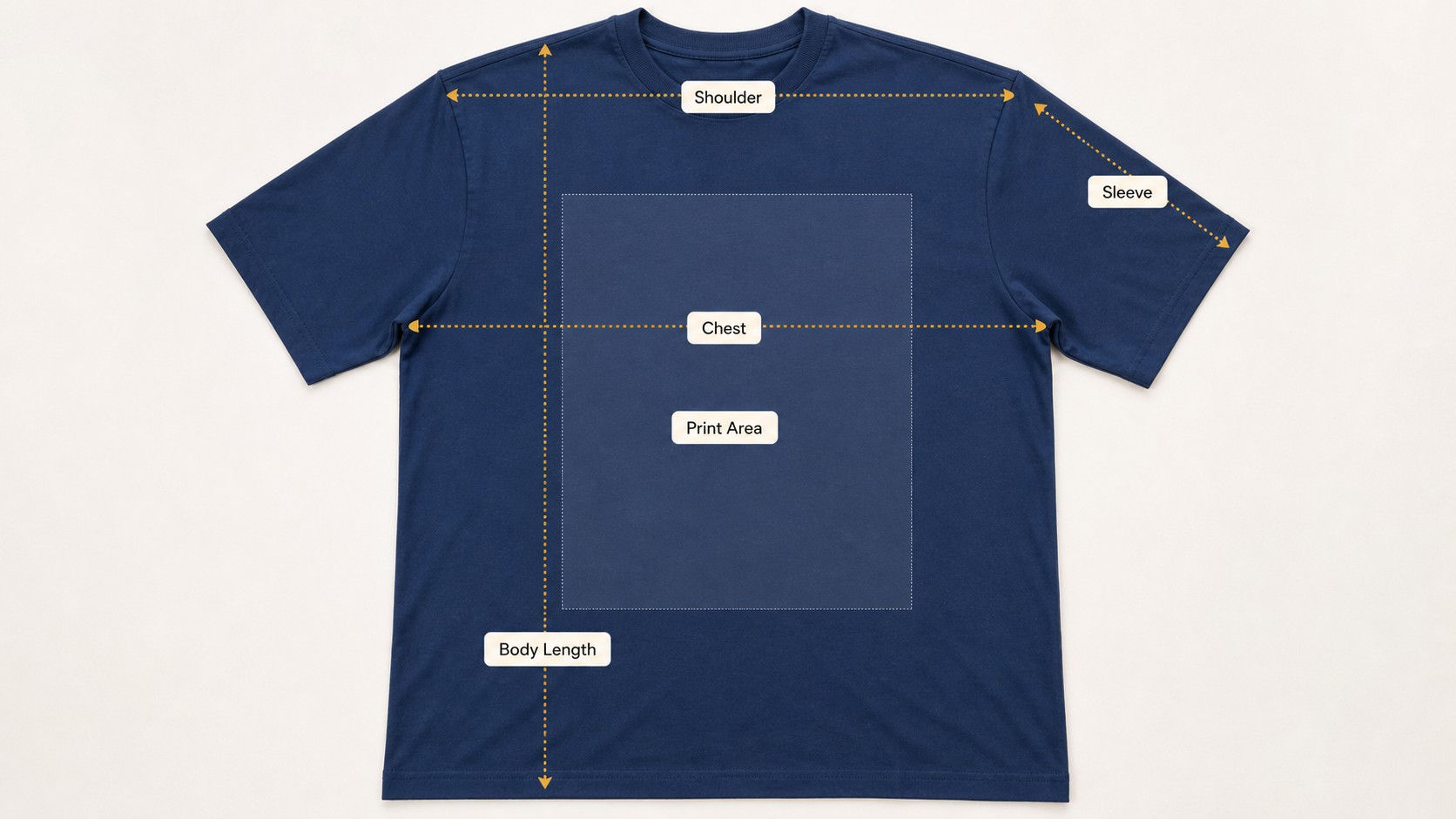
Chest (or bust): Lay the t-shirt flat. Measure across the chest, one inch below the armpit seam. Double this number for the full chest circumference.
Body length: Measure from the highest point of the shoulder seam (where the collar meets the shoulder) straight down to the bottom hem.
Sleeve length: Measure from the shoulder seam to the end of the cuff. For raglan sleeves, measure from the neckline.
Buyer Check: Always measure a garment that has been washed and dried at least once. Raw-cut fabric can shrink 5–8% after the first wash, depending on cotton content and fabric weight.
Men's T-Shirt Sizing: What to Watch For
Men's t-shirts are the most straightforward category, but sizing still varies by fit type and fabric weight.
A standard-fit men's medium typically measures 39–41" chest and 29" length. A heavy-cotton version (around 200+ GSM) may run slightly larger because thicker fabric adds body. A ringspun cotton t-shirt in the same size may fit slimmer because the fabric drapes closer.
When ordering custom men's tees, confirm three things with your manufacturer:
Grade rule: How many inches does each measurement jump between sizes? A common grade is 2" chest and 1" length per size, but this varies.
Fit description: Standard, slim, or relaxed? Each changes the target measurements.
Shrinkage allowance: Has the manufacturer pre-shrunk the fabric, or do you need to add shrinkage tolerance to your specs?
Women's T-Shirt Sizing: Fit and Cut Differences
Women's t-shirts use bust measurements instead of chest measurements and tend to have shorter body lengths, narrower shoulders, and contoured side seams.
The jump from women's to unisex sizing catches many buyers off guard. A women's medium (37–39" bust) is roughly equivalent to a unisex small (36–38" chest), but the shoulder width, sleeve length, and body shape differ significantly.
If you're offering both women's and unisex options on the same design, create a dual size chart so customers can compare. This reduces return rates more than any other single change you can make to your product page.
Youth and Kids T-Shirt Sizing by Age
Youth sizing is age-based, which creates a problem: children of the same age can vary by 4–6 inches in height and 3–5 inches in chest measurement.
Always size youth t-shirts by chest measurement, not age alone. The age range on a size chart is a starting point, not a guarantee.
For custom youth apparel orders:
Request a measurement chart that lists both age range and chest circumference
Order one sample per size before committing to bulk
Consider adding a 1-inch growth allowance if the shirts are for events scheduled weeks ahead
Unisex T-Shirt Sizing Explained
Unisex t-shirts are typically built on a men's sizing block with slight modifications — slightly narrower shoulders, a touch more length, and a straight body. This makes them versatile for group orders, events, and merch lines where you don't want to stock separate men's and women's cuts.
The trade-off: unisex sizing doesn't flatter all body types equally. Women who typically wear a women's medium may find a unisex medium too boxy, while a unisex small may be too short.
| Women's Size | Closest Unisex Equivalent | Notes |
|---|---|---|
| XS | XS / S | Unisex may run longer |
| S | S | Similar chest, different cut |
| M | S / M | Size down for fitted look |
| L | M / L | Size down for slimmer fit |
| XL | L | Shoulder width increases |
Regional Size Conversion: US, EU, UK, and Asia
If you're selling internationally or sourcing from overseas factories, regional size conversion is unavoidable. The chart below is a general reference — confirm with your manufacturer for production-grade accuracy.
| US Size | EU Size | UK Size | Asia (CN/JP) |
|---|---|---|---|
| XS | 44 | 34 | 160/84A |
| S | 46 | 36 | 165/88A |
| M | 48 | 38 | 170/92A |
| L | 50 | 40 | 175/96A |
| XL | 52 | 42 | 180/100A |
| 2XL | 54 | 44 | 185/104A |
| 3XL | 56 | 46 | 190/108A |
Factory Tip: Asian size labels (like 170/92A) encode height and chest measurement directly. 170/92A means the garment fits a person approximately 170 cm tall with a 92 cm chest. When communicating with Asian factories, using this format reduces sizing confusion.
Fit Types and How They Change Sizing
The same size label can fit dramatically differently depending on the cut. Here's how common fit types affect measurements:
| Fit Type | Chest Fit | Length | Body Shape | Typical Use |
|---|---|---|---|---|
| Standard | True to size | Regular | Straight | Everyday basics, uniforms |
| Slim | 1–2" tighter | Shorter | Tapered | Fashion-forward brands |
| Relaxed | 1–2" looser | Regular | Straight | Streetwear, comfort lines |
| Oversized | 3–4" looser | 1–2" longer | Boxy | Streetwear, trend pieces |
| Tall | Same chest | 2–3" longer | Straight | Big & tall, extended sizes |
Rule of Thumb: If you're ordering oversized t-shirts, don't just buy a larger standard size. The proportions change — oversized cuts widen the body and shoulders without just lengthening the shirt. Specify "oversized fit" in your tech pack so the manufacturer grades the pattern correctly.
Print and Design Placement Sizes for Custom T-Shirts
If you're ordering custom-printed t-shirts, the design size matters as much as the garment size. A print that's too large for a youth small looks awkward; one that's too small on a 3XL looks lost.
Standard Print Placement Guide (Adult)
| Print Location | Recommended Width | Notes |
|---|---|---|
| Full chest (front) | 10–12 in | Centered, 3–4" below collar |
| Left chest | 3–4 in | Placed 7–9" from left shoulder seam |
| Full back | 11–14 in | Centered, 5–6" below collar |
| Sleeve | 2.5–4 in | Placed 1" above sleeve hem |
Standard Print Placement Guide (Youth)
| Print Location | Recommended Width | Notes |
|---|---|---|
| Full chest (front) | 7–9 in | Scaled proportionally |
| Left chest | 2.5–3 in | Smaller logo placement |
| Full back | 8–10 in | Adjust by youth size |
| Sleeve | 2–3 in | Keep design simple |
Buyer Check: When you send artwork to your manufacturer, include the target print dimensions for each garment size. Don't assume the factory will scale automatically. For multi-size orders, create a print-size matrix that lists design dimensions for every size in your run.
How Sizing Works in Custom Apparel Production
Understanding how sizing translates to the factory floor helps you avoid the most expensive mistakes in custom apparel.
Size Grading
Grading is the process of scaling a base pattern (usually a medium) up and down to create the full size run. Each measurement — chest, length, sleeve, shoulder, neck — has its own grade rule.
A typical grade rule adds 2" to chest and 1" to length per size, but heavy-cotton fabrics, tall sizes, and oversized fits use different increments. Your manufacturer's grade rule determines whether your 2XL actually fits like a 2XL.
Tech Pack Requirements
Your tech pack should include:
A size chart with measurements for every size in your run
Grade rules (incremental changes between sizes)
Fit description (standard, slim, relaxed, oversized)
Point of measure (POM) diagram showing exactly where each measurement is taken
Shrinkage tolerance if fabric is not pre-shrunk
Sample Approval
Sample development usually takes 3–7 days, depending on product complexity and fabric availability. When you receive a sample:
Measure every POM listed in your tech pack
Compare against your size chart
Note any deviation greater than 0.25"
Request adjustments before approving for bulk
Factory Tip: Approve the medium sample first. Once the medium is confirmed, ask the factory to grade the full size run and provide a measurement chart for every size. This catches grading errors before they multiply across hundreds of units.
How SuhuCustom Handles T-Shirt Sizing for Custom Orders
SuhuCustom is a source apparel factory based in Humen, Dongguan, China, providing OEM/ODM custom apparel manufacturing. When you order custom t-shirts, sizing is handled through a structured process:
Size chart development: Send your existing size chart, or work with the SuhuCustom team to develop one based on your target fit and demographic. You can specify men's, women's, youth, unisex, or mixed size runs.
Tech pack review: Your measurements, grade rules, and fit description are documented in a tech pack before sampling begins. This ensures the factory and the buyer are working from the same numbers.
Sample development (3–7 days): A physical sample is produced in your target fabric and fit. You measure it against the approved size chart and request adjustments if needed.
Grading verification: Once the base sample is approved, the full size run is graded. The factory provides measurements for each size so you can verify the grade rule was applied correctly.
Pre-shipment inspection: Before bulk shipment, measurements are checked against the approved size chart. This catches any drift that occurred during bulk cutting and sewing.
Because SuhuCustom operates factory-direct, you communicate sizing adjustments without a trading company layer in between. Flexible MOQ means you can order a small-batch trial run to test fit across your size range before committing to full volume.
Buyer Checklist: Size Chart Approval Before Bulk
Use this checklist before approving any custom t-shirt order for production:
Size chart includes chest, length, and sleeve measurements for every size
Measurements are listed in both inches and centimeters
Grade rule is documented (increment between each size)
Fit type is specified (standard, slim, relaxed, oversized, tall)
Fabric weight (GSM) and composition are confirmed
Shrinkage tolerance is noted if fabric is not pre-shrunk
Sample has been measured against the size chart (deviations under 0.25")
Print placement dimensions are specified for each size
Regional conversion is noted if selling internationally
Pre-shipment measurement inspection is included in the production agreement
Final CTA
Getting your t-shirt size chart right is the difference between a smooth production run and a warehouse full of returns. The measurement tables, grade rules, and production checkpoints in this guide give you the framework — but the real accuracy comes from factory-direct communication, sample approval, and pre-shipment inspection.
If you're planning a custom t-shirt order, SuhuCustom can help you develop an accurate size chart, produce samples in 3–7 days, and verify measurements across your full size run before bulk ships. Send your tech pack, size chart, or even a rough idea of your target fit and demographic — the team will help you lock down the numbers.