Apron Size Chart: The Complete Measurement & Fit Guide
Apron sizing has no universal standard. Match bib width, total length, and strap length to each wearer's measurements, and choose the larger size when uncertain.
AI-generated summary
An apron size chart maps body measurements to product dimensions — bib width, total length, waist strap length, and chest-to-waist distance — so you can order the right size for every wearer. There is no universal apron sizing standard across manufacturers. When sizing is uncertain, choose the larger size for more coverage and unrestricted movement. Custom apron manufacturing — including factory-direct OEM/ODM services — gives you full control over every dimension, from bib width to strap length, and a pre-production sample lets you verify fit before committing to bulk.
Standard Apron Size Categories
Most apron manufacturers offer five core size tiers. The table below shows typical dimensions for bib-style aprons with adjustable neck straps.
| Size | Width × Total Length | Neck Strap Length | Bib Width (approx.) | Bib-to-Waist Distance | Single-Side Waist Strap |
|---|---|---|---|---|---|
| Big and Tall | 37″ × 36″ | 15–29″ | 9.6″ | 11.5″ | 50″ |
| Regular Adult | 33″ × 32″ | 16–28″ | 9.2″ | 11.25″ | 40″ |
| Petite | 27″ × 30″ | 16–28″ | 8.5″ | 11.0″ | 40″ |
| Junior-Teen | 27″ × 30″ | 16–28″ | 8.5″ | 10.5″ | 40″ |
| Kids | 20″ × 20″ | 8–20″ | 6″ | 8″ | 20″ |
The dimensions above represent a common industry baseline. Individual manufacturers may deviate — for example, some offer a "wide bib" option that adds 1 inch to each side of the bib width.
Rule of Thumb: The bib-to-waist distance (measured from the top of the bib down to the waist tie attachment point) determines where the apron sits on the torso. A shorter distance places the waist tie higher, which can look cropped on longer torsos.
Apron Styles and Their Sizing Differences
Apron styles handle sizing differently because each uses a distinct strap and panel system. Understanding these differences helps you choose the right style and size for your team.
Bib Apron (with Adjustable Neck Strap)
The bib apron uses a neck loop that goes behind the neck and two separate waist ties that wrap around and tie at the front or back. The neck strap is typically adjustable, allowing you to raise or lower the bib's position on the chest.
The bib apron's neck strap length is usually 15–29 inches, giving enough range to accommodate different torso lengths. Waist straps for adult sizes typically run 40–50 inches per side.
Cross-Back Apron
The cross-back apron eliminates the neck strap. Instead, two long straps start from the bib's top corners, cross over the back, and wrap around to tie at the waist. This design distributes weight across the shoulders rather than the neck.
Cross-back strap lengths are longer than standard waist ties — typically 68–78 inches per side — because each strap must travel from the bib top, across the shoulder, down the back, and around the waist.
| Size | Width × Total Length | Bib Width (approx.) | Bib-to-Waist Distance | Single-Side Shoulder-to-Waist Strap |
|---|---|---|---|---|
| Big and Tall | 37″ × 36″ | 9.6″ | 11.5″ | 78″ |
| Regular Adult | 33″ × 32″ | 9.2″ | 11.25″ | 68″ |
| Petite | 27″ × 30″ | 8.5″ | 11.0″ | 68″ |
| Junior-Teen | 27″ × 30″ | 8.5″ | 10.5″ | 68″ |
Buyer Check: Measure the strap length from the bib top point, following the path it would take over the shoulder and around the waist. Cross-back straps that are too short will ride up or fail to tie securely.
Gender-Specific Apron Sizing
Men's and women's aprons differ in chest-to-hip proportions, bib width, and built-in ease allowance. Gender-specific sizing becomes important for bulk uniform orders where a single "unisex" cut will not fit all wearers well.
Men's Apron Size Chart (with Ease Allowance)
Men's apron sizes include 3 inches of chest ease for standard sizes and 3–4 inches for XL and above. All measurements are in inches.
| Size | Height | Chest (with ease) | Waist | Hip | Front Panel Length | Front Panel Width | Total Length |
|---|---|---|---|---|---|---|---|
| XS | 5'2″ | 36″ | 32″ | 34″ | 34″ | 19″ | 36″ |
| S | 5'4″ | 39″ | 34″ | 36″ | 34″ | 21″ | 36″ |
| M | 5'8″ | 42″ | 38″ | 40″ | 37″ | 22″ | 38″ |
| L | 5'11″ | 46″ | 42″ | 44″ | 40.5″ | 24″ | 40.5″ |
| XL | 6'2″+ | 50″ | 46″ | 48″ | 42.5″ | 26″ | 42.5″ |
| 2XL | 6'2″+ | 54″ | 50″ | 52″ | 42.5″ | 28″ | 42.5″ |
| 3XL | 6'2″+ | 58″ | 54″ | 56″ | 45.5″ | 30″ | 45.5″ |
Women's Apron Size Chart (with Ease Allowance)
Women's sizes include 3 inches of chest ease for standard sizes and 3–4 inches for XL and above. Hip measurements are proportionally wider than men's to accommodate body shape.
| Size | Height | Chest (with ease) | Waist | Hip | Front Panel Length | Front Panel Width | Total Length |
|---|---|---|---|---|---|---|---|
| XS | 5'1″ | 33″ | 25″ | 35″ | 33″ | 18″ | 33″ |
| S | 5'2″ | 35″ | 27″ | 37″ | 34″ | 19″ | 34″ |
| M | 5'5″ | 37″ | 29″ | 39″ | 36″ | 20″ | 37″ |
| L | 5'8″ | 40″ | 32″ | 42″ | 38.5″ | 21″ | 40.5″ |
| XL | 5'10″ | 43″ | 35″ | 46″ | 40.5″ | 23″ | 42.5″ |
| 2XL | 5'11″ | 46″ | 40″ | 48″ | 42.5″ | 24″ | 42.5″ |
| 3XL | 5'11″ | 49″ | 44″ | 52″ | 42.5″ | 26″ | 44.5″ |
Rule of Thumb: The front panel width is the critical fit dimension. It should cover the chest without excess fabric at the sides. If your wearers span a wide size range, order a sample in each size tier (XS–M for smaller builds, L–3XL for larger builds) to verify coverage before bulk production.
Body Type Fit Recommendations
Different body types require different apron styles: tall users need full-length bib aprons (37–40 inches), petite users need reduced bib widths (27–29 inches), wide-waist users benefit from cross-back designs, and broad-shouldered wearers should choose H-back or cross-back designs that distribute weight evenly.
| Body Type | Recommended Style | Why It Works |
|---|---|---|
| Tall / Broad-shouldered (over 6'0″) | Full-length bib, Big and Tall sizing | Extended hem provides full-body coverage; wider bib prevents side exposure |
| Petite (under 5'6″ / 167 cm) | Petite bib, shortened length | Narrower bib and shorter hem prevent fabric from bunching or dragging |
| Wide waist / Large build | Cross-back design | Extra-long one-piece straps (68–78″) accommodate larger waist circumferences without separate ties |
| Broad shoulders | H-back or cross-back design | Weight distributed across both shoulders rather than concentrated on the neck |
| Seated / workshop use | Short craft apron (27–30″) | Shorter hem allows sitting without the apron bunching at the lap |
Factory Tip: For teams with diverse body types, the cross-back design offers the most sizing flexibility. Its long continuous straps adjust to a wide range of torso lengths and waist sizes with one design, reducing the number of distinct sizes needed in your order.
Apron Fabrics and Sizing Considerations
Fabric weight and drape affect how an apron fits and how precisely you need to size it. Heavier fabrics are less forgiving and require more accurate measurements.
Cotton
Cotton aprons are lightweight, breathable, and have natural drape. The fabric conforms to the body, making cotton aprons more forgiving if the size is slightly off. Cotton works well for home cooking, front-of-house service, and light-duty kitchen tasks. It is easy to wash and prints well for branded designs.
Canvas / Heavy Cotton
Canvas aprons (typically 7–10 oz weight) are stiff with minimal drape. The fabric holds its shape rather than conforming to the body — this means sizing needs to be more precise. A canvas apron that is too narrow will gap at the sides; one that is too wide will feel bulky and restrict arm movement.
Canvas is the standard choice for professional kitchens, barbecue, woodworking, and heavy-duty workshops because it resists abrasion, blocks heat, and withstands frequent washing.
Buyer Check: If switching from cotton to canvas for the same apron design, verify the size chart again. Canvas's stiffness means the same cut dimensions will fit differently than cotton. Order a pre-production sample in canvas before committing to bulk.
Commercial Kitchen Apron Standards
Professional kitchens typically use three standard bib apron dimensions, with sizes scaled for coverage and movement.
| Style | Dimensions (L × W) | Best For |
|---|---|---|
| Chef's Bib (Oversized) | 40″ × 39″ | Heavy back-of-house use, full-coverage protection against oil and heat |
| Standard Bib | 34″ × 30″ | General kitchen and service roles, balanced coverage and mobility |
| Petite Bib | 29″ × 29″ | Smaller frames, front-of-house service, lightweight tasks |
The Chef's Bib is approximately 6 inches longer and 9 inches wider than the Standard Bib. It is designed for chefs who spend hours at the line and need maximum coverage. The Petite Bib is 11 inches shorter and 10 inches narrower than the oversized chef version, making it practical for smaller-framed staff who find full-size bibs unwieldy.
How to Measure Yourself for an Apron
To measure for an apron, take three measurements — chest, length, and waist — all while wearing the work clothing that will be worn under the apron. Chef coats, work shirts, and layered clothing add bulk that affects fit, so measuring in actual workwear prevents ordering sizes that are too tight.
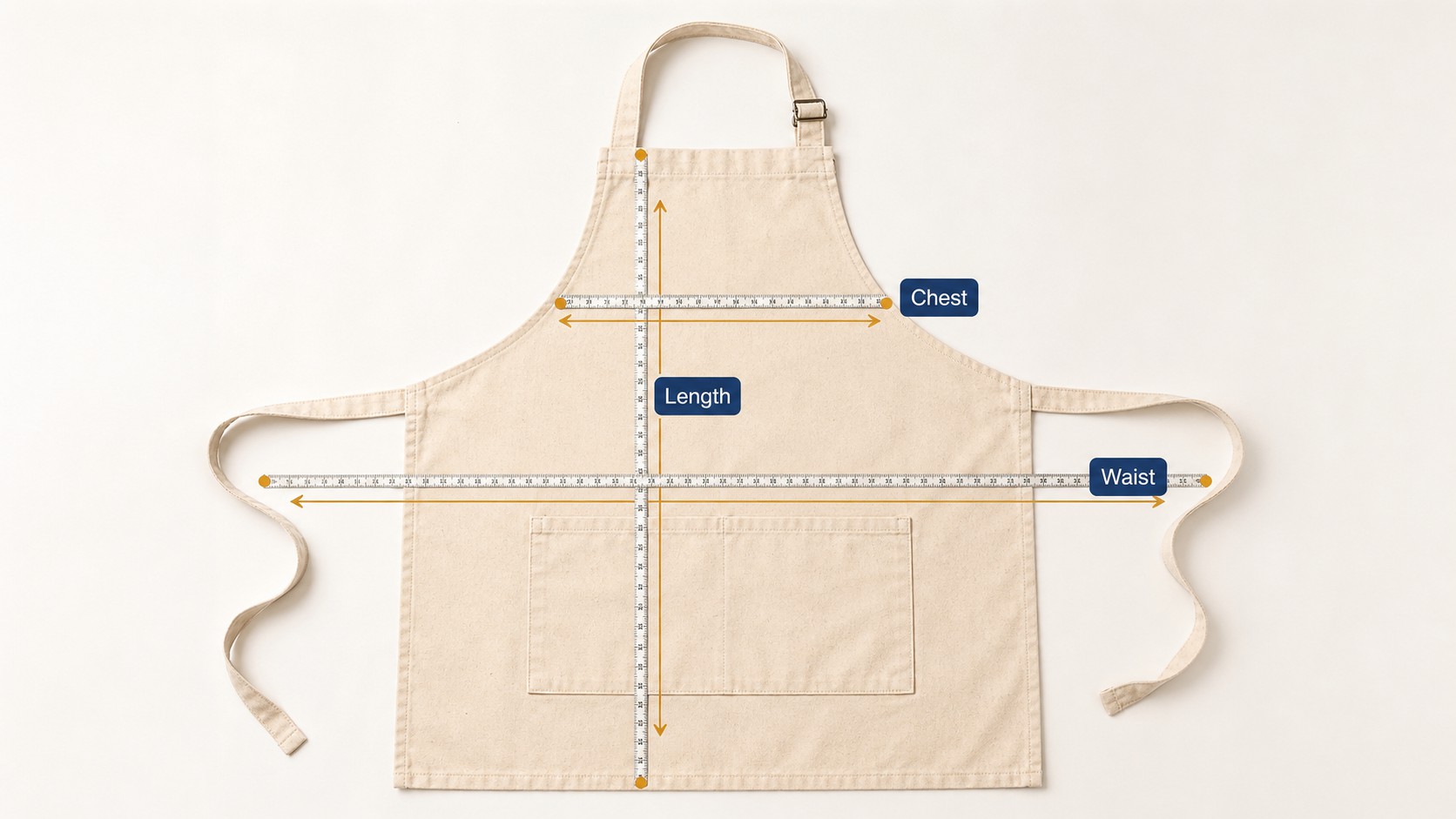
Step 1: Measure Your Chest
Wrap a measuring tape around the fullest part of your chest while wearing your normal work clothing. Keep the tape parallel to the floor and allow it to sit comfortably — not tight. If you typically wear a chef coat or heavy shirt under the apron, add 1–2 inches of ease to this measurement.
The chest measurement determines which bib width you need. A bib that is too narrow leaves the sides of the chest exposed; a bib that is too wide creates excess fabric.
Step 2: Determine Your Ideal Apron Length
Measure from the top of your shoulder — where the apron neck strap would sit — down to your desired hem point. For kitchen aprons, this typically falls between mid-thigh and just above the knee. For full-coverage work aprons, measure to the knee or slightly below.
A reliable height-to-length reference:
Height under 5'6″ (167 cm) → 34–36 inch apron length
Height 5'6″–6'0″ (167–183 cm) → 36–38 inch apron length
Height over 6'0″ (183 cm) → 38–40 inch apron length
Step 3: Measure Your Waist for Strap Sizing
Measure around your natural waistline — the narrowest point of your torso, typically just above the belly button. This measurement helps you verify whether the apron's waist strap system provides enough length.
For standard bib aprons with two separate waist ties, the formula is: left strap length + apron body width + right strap length = total encirclement. The total must exceed your waist measurement with room to tie.
For cross-back aprons, a single continuous strap wraps from the bib top down the sides and ties at the waist. These straps are typically longer (68–78 inches per side) and accommodate a wider range of waist sizes.
Custom Apron Sizing and Features
Custom apron manufacturing gives you full control over dimensions, details, and functional add-ons. This is particularly valuable for uniform programs where off-the-shelf sizes do not fit your team.
What Can Be Customized
Overall length: Extend or shorten the apron body beyond standard size tiers
Bib width: Widen the bib (typically up to 1 inch per side) for broader chest coverage
Strap length: Lengthen waist ties or cross-back straps for larger waist circumferences
Strap color: Change strap or tie color independently from the apron body
Branding: Add embroidered logos, screen-printed text, or custom woven labels
Accessories: Add towel loops, multi-compartment pockets, quick-release buckles, or reinforced stitching at stress points
Fabric selection: Choose between cotton, canvas, or blended fabrics depending on durability and hand-feel requirements
Functional Add-Ons Worth Considering
Multi-compartment pockets: Store thermometers, pens, order pads, and tools in separate sections
Waist towel loop: Keep a towel within reach for wiping hands without contaminating clothing
Water-resistant coating: Block oil and liquid penetration through the fabric
Quick-release buckle: Allows one-handed removal in emergencies — important for kitchen safety
Reinforced bartack stitching: Strengthens pocket corners and strap attachment points against daily pulling and weight
SuhuCustom produces fully customizable aprons from its factory in Humen, Dongguan. You can specify dimensions for every component — bib width, total length, strap type and length, pocket placement, and accessory attachments. A pre-production sample lets you verify fit and details before bulk production begins.
Common Apron Sizing Mistakes
The most frequent apron sizing errors are ignoring strap length, choosing a bib width too narrow for the chest, not accounting for clothing layers, ordering one size for an entire team, skipping the pre-production sample, and overlooking how fabric weight changes fit. Each mistake below has a straightforward fix.
Ignoring strap length. Waist straps that are too short to wrap and tie around the wearer's waist are the single most common sizing failure. Verify that the total strap encirclement (left strap + apron width + right strap) exceeds your largest wearer's waist measurement by at least 10–12 inches for comfortable tying.
Choosing bib width too narrow for the chest. A bib that exposes the sides of the wearer's chest fails its primary function — coverage. Compare the bib width against the widest chest measurement in your team, including ease for work clothing.
Not accounting for clothing layers. Apron sizes measured over a T-shirt will be too tight when worn over a chef coat or sweater. Always measure or specify chest dimensions including the intended under-layer.
Using one size for an entire team. A single "one size fits all" apron order leads to some staff swimming in fabric while others are under-covered. Order at least two size tiers (Regular and Big and Tall) or offer adjustable cross-back designs that accommodate a broader fit range.
Skipping the pre-production sample. Dimensions on a spec sheet do not tell you how the apron actually drapes, how the straps feel on shoulders, or whether the bib sits at the right height on a real person. A sample is the cheapest insurance against a full production run in the wrong size.
Overlooking fabric weight's effect on fit. A switch from cotton to canvas with identical cut dimensions will produce a noticeably different fit. The stiffer fabric does not drape the same way. Re-verify sizing when changing materials.
Get a Custom Apron Quote from SuhuCustom
A size chart gives you the numbers — but getting aprons that fit your entire team means matching those numbers to real bodies, fabrics, and daily movement.
SuhuCustom manufactures custom aprons with full dimensional control. You define the bib width, total length, strap type and length, pocket layout, and accessory attachments. Choose between cotton, canvas, or blended fabrics. Add your logo through embroidery, screen printing, or heat transfer. A pre-production sample confirms fit before bulk production.
For uniform programs, restaurant chains, and branded merchandise, custom sizing ensures every apron in the order fits the wearer it was made for.